
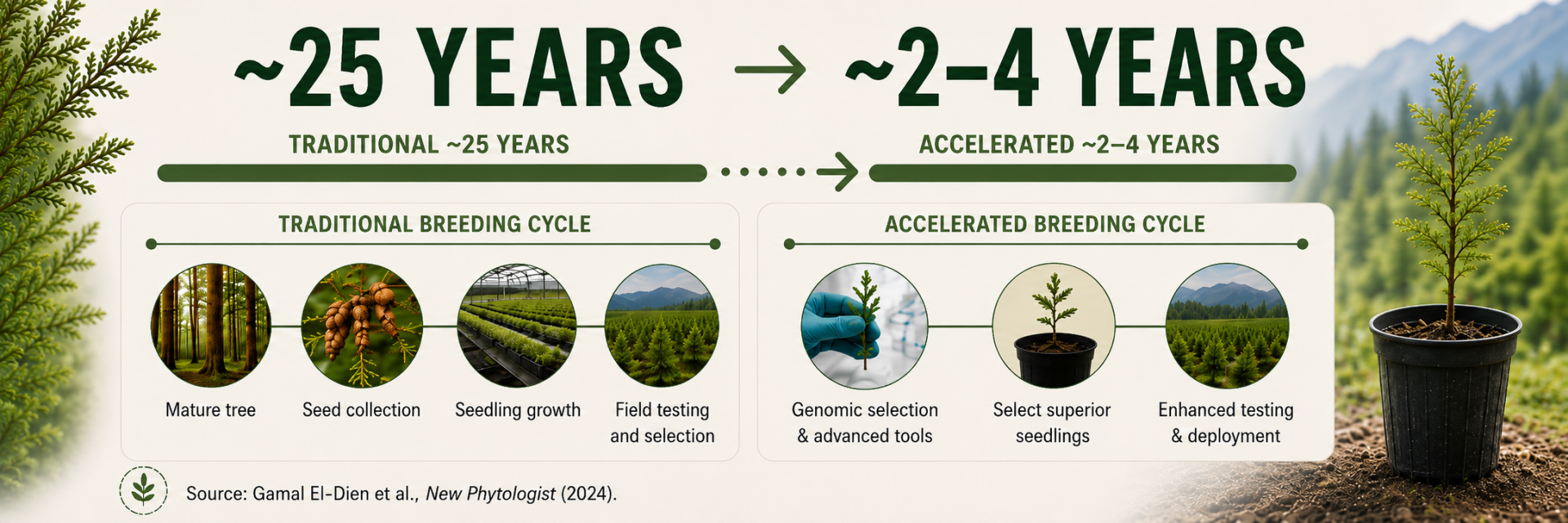
Breeding a better tree takes time. In western redcedar, conventional breeding cycles can span about 25 years before a new generation can be fully evaluated and advanced. [1]
Genome BC supported research has helped move genomic selection in western redcedar from proof of concept to operational application. Researchers used genomic data from young trees to predict how they would perform on growth, heartwood chemistry and foliar chemistry, then used those predictions to select trees for breeding.[1]
This use of genomic selection could cut breeding timelines from 25 years to just four years. [1]
Building on years of forest genomics
Western redcedar is an important commercial species in British Columbia, and the province’s coastal western redcedar breeding program aims to improve volume and adaptability while preserving resilience to foliage pathogens, ungulate damage and heartwood rots. [1]
The Cedar Enhanced Durability and Resistance to Blight & Browse project, known as CEDaR B2, built on earlier genomic selection work by broadening screening for resistance to deer browsing and foliar fungal disease. More than 2,100 tree samples from the Nimpkish and Cowichan Clonal Training populations were analyzed using metabolomic profiling [1].
From prediction to practice
In 2024, the project team reported that genomic selection had been implemented and integrated into an operational western redcedar tree breeding program. [1]
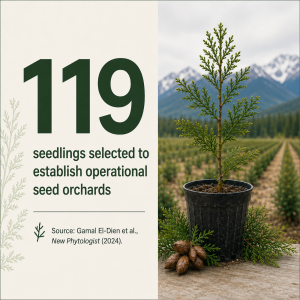
Using genomic predictions and multi-trait selection, researchers selected 119 seedlings from the target population to establish operational seed orchards decades earlier than traditional breeding would have allowed. [2]
 From prediction to practice
In 2024, the project team reported that genomic selection had been implemented and integrated into an operational western redcedar tree breeding program. [1]
Using genomic predictions and multi-trait selection, researchers selected 119 seedlings from the target population to establish operational seed orchards decades earlier than traditional breeding would have allowed. [1]
A stronger breeding toolkit
Genomic selection. A 2024 study used genomic data to predict breeding values for growth, heartwood chemistry and foliar chemistry traits in a target seedling population. [1]
Earlier disease screening. CEDaR B2 developed a new foliar disease resistance screening system that is currently used by the BC Ministry of Forests to identify resistant clones. [1]
Multi-trait selection. The 2024 study combined genomic predictions across multiple traits to select seedlings for operational seed orchards, balancing genetic gain and diversity. [1]
Already part of BC’s breeding program
Four western redcedar seed orchards (one government and three industry orchards) are producing genetic gains, including increased volume and resistance to cedar leaf blight, approximately 20% greater than in a wild stand. [1]
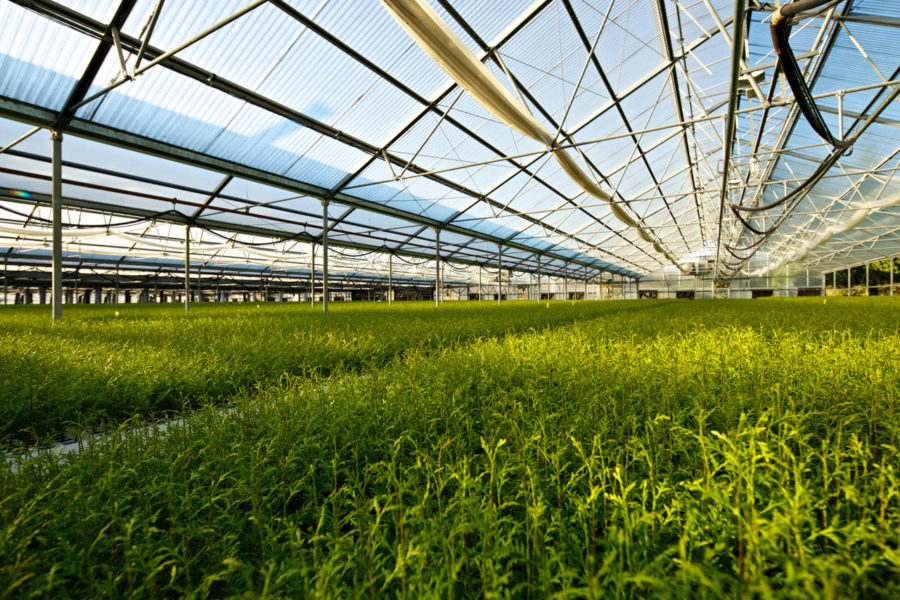
Seedlings in a greenhouse at Western Forest Products’ Saanich Forestry Centre. The company plants over two million western redcedar seedlings each year in BC. Photo: WFP.
Why it matters
The provincial breeding program identifies climate change and rising pest pressure as key challenges for western redcedar. The 2024 New Phytologist study concludes that genomic selection can shorten the breeding cycle for late expressed traits, enabling breeders to make selections much earlier than conventional breeding would allow. [1]
Faster selection does not make forests resilient overnight. It gives breeders a faster way to select for the traits their breeding program prioritizes in future generations.
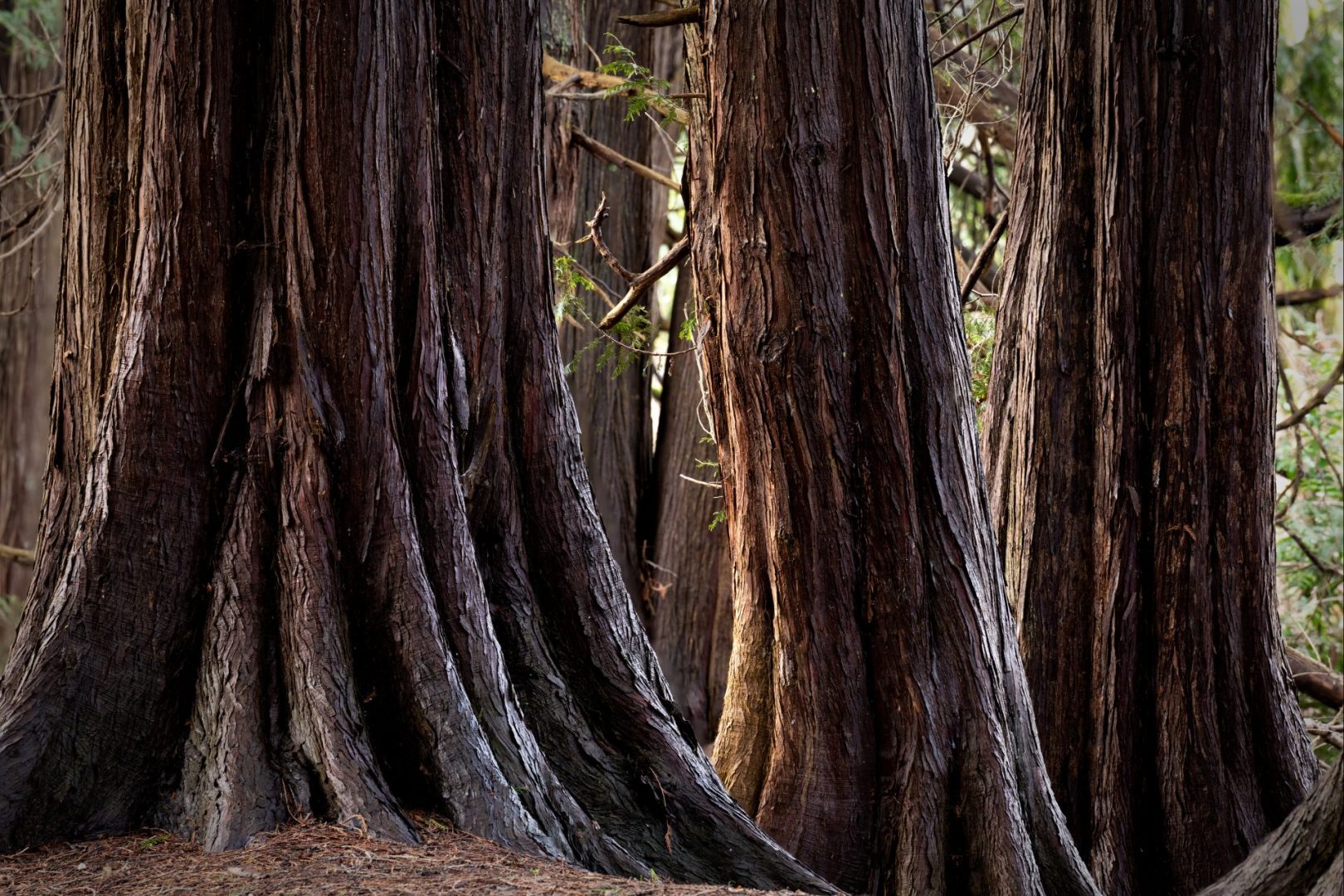
Three western red cedars, Victoria, BC Canada
Explore the science
See genomic selection in action. Read the 2024 open-access New Phytologist study describing the progression from proof of concept to operational application in western redcedar. Open the research paper
Explore BC’s western redcedar breeding program. See the Province’s current overview of program objectives, orchard gains and breeding priorities. Visit the BC breeding-program page
