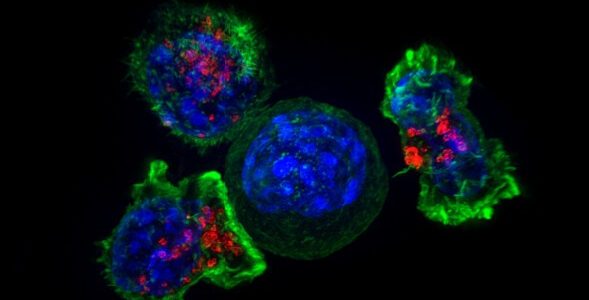
Cancer remains a leading cause of death worldwide and the tools researchers rely on to fight it need to keep pace. Three new Genome BC funded projects are strengthening the infrastructure to support cancer research. With two projects building the foundations for precision therapies and one ensuring reliable research tools, these collaborations promise new options for the future of cancer care in British Columbia.
Using our immune cells as cancer therapy
T cells are a part of the body’s defence system. Each of these cells contains its own T cell receptor (TCR), a protein that looks for foreign or mutated molecules called antigens that are on target cells. The TCR can then bind itself to the cell and signal the T cells to destroy it.
TCRs target specific antigens, including proteins carried by tumour cells, making them powerful tools to fight diseases such as cancer. In clinical studies, TCR-based therapies are already saving lives, but they are still in their infancy.
To move into real world use, researchers need to solve a core limitation that creates risks: they need TCRs that destroy targets such as cancer cells without harming healthy tissue. But not all TCRs manage this. When healthy tissues are attacked by mistake, this is called off-target reactivity, causing issues that can be fatal.
TCRs are biologically complex and there is currently no standard for assessing the viability of new therapies. Many AI and machine learning methods are still not accurate enough to predict which TCRs are the most viable for clinical use.
Dr. Govinda Sharma is leading a team at Immfinity Biotechnologies in this project to accelerate this search process with a proprietary assay system called Tope-seq. Based on real cells, the system allows TCRs to be tested against millions of potential targets for off-reactivity.
This allows TCRs to be analyzed with synthetic biology, high-speed cell sorting and DNA sequencing to make sure that the best TCR molecules will make it to the next stage.
The project team will be pursuing several targets in their work. They hope that this research can contribute to more TCR-based therapy options to fight different cancers and support more biotherapeutic developments in British Columbia.
A targeted therapy for esophageal cancer
Precision oncology approaches have plenty of potential to improve cancer outcomes. However, around 86% of patients aren’t eligible for current targeted therapies because every patient’s cancer is unique in terms of which therapies can be effective.
Dr. Dermot Kelleher (University of British Columbia Faculty of Medicine) and his team are developing a novel precision therapy called the Tumour Amplified Transient Molecular Switch (TATMS). This technology provides a focused way to supress the activation of target genes in cancer-specific molecular and genetic profiles.
The approach should prevent specific genes from triggering cancer growth and spread, allowing TATMS to activate cancer-killing therapy only in cells where needed. This increases the chance of more accurately targeting cancer-related genes and bypasses challenges such as when tumour cells evolve and resist treatment.
The project involves applying the TATMS platform to esophageal adenocarcinoma (EAC), an aggressive and increasingly common form of esophageal cancer with a low survival rate and limited targeted therapies.
“This innovation presents a transformative opportunity in the precision oncology space,” Dr Kelleher says.
The team will be identifying EAC-specific genetic datasets and developing prototypes for testing, eventually pursuing top-performing candidates for clinical adoption and commercial use. They hope this will one day open a path to potential treatment options for other difficult cancers.
Validating critical antibodies to improve cancer research
Our DNA provides the blueprint to make over 20,000 proteins that carry out essential build and repair work in our bodies. In some cases, genetic defects can alter a protein’s normal function, which can interfere with a person’s well-being.
Studying proteins in both their normal and abnormal states can help researchers develop novel disease biomarkers and therapeutics. A common method begins with protein validation analysis using commercially available antibodies.
However, evidence suggests that at least half of commercial antibodies do not function as expected.
Antibodies are designed to detect specific proteins, so they require detailed cellular and molecular analysis to ensure they bind their targets effectively. To address this challenge, a process is necessary to validate antibodies for specific use.
Dr. Phil Barker (University of British Columbia Okanagan) and Chetan Raina (YCharOS Inc.) are leading a collaboration between research labs and commercial antibody manufacturers to create transparent, accessible analysis. The YCharOS Inc. platform has to date been used at McGill University to evaluate commercial antibodies for neurological conditions.
Genome British Columbia funding will help the team to set up their platform at the University of British Columbia, where they can apply their rigorous testing to antibodies relevant to cancer. By working with BC research institutes and small and medium enterprises, the team will help validate research antibodies against high-priority cancer targets.
###
Contact: Genie Tay, Communications Manager
Referenced projects: GIF009, GIF011, GEN063