By Anita Charters and Dorota Stefanowicz
*This is part two of a two-part series on Genome BC’s new Policy and Research Innovation Lab (PRIL) and its new approaches to tackle biodiversity challenges facing British Columbia. Read part one here: “Genomics Meets Policy: Launching Genome BC’s Policy and Research Innovation Lab (PRIL)“
—
While the Kunming-Montreal Global Biodiversity Framework has set urgent international targets, translating these into local action remains a challenge. In British Columbia, the primary obstacle is not a lack of data, but a lack of coordination between government, academia and Indigenous rightsholders. Genome BC’s new Policy and Research Innovation Lab (PRIL) addresses this by centralizing biodiversity efforts. Through leveraging tools like genomic monitoring and facilitating interdisciplinary cooperation, PRIL aims to harmonize technical innovation with social and economic policy, ensuring BC’s conservation strategies are both scalable and scientifically robust.
A new Idea is born
PRIL’s first initiative was an Ideas Lab entitled “Biodiversity in BC: Future Visions and Novel Solutions.” An Ideas Lab (or Sandpit) is a collaborative forum designed to address ‘wicked problems’: societal issues that lack clear solutions and require novel and progressive ideas. The biodiversity crisis is one of these wicked problems. Solving it requires participants to examine the challenge from new and diverse perspectives, including different academic lenses and cultural worldviews. Finding solutions also demands moving beyond investigating scientific questions and onto the identification and exploration of social and economic challenges hindering progress.
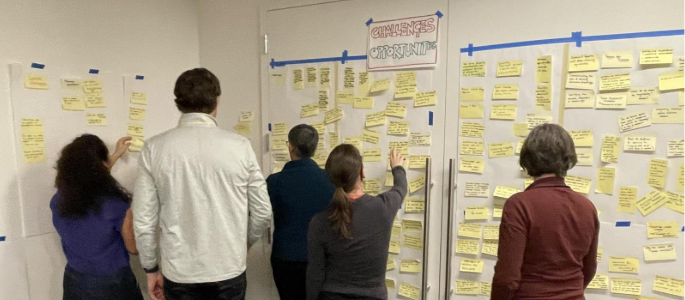
The Ideas Lab was held from March 31st to April 2nd, 2025, at the Genome BC office in Vancouver. The agenda was designed to transition participants from broad problem-solving to concrete project development through a structured, collaborative process led by an expert facilitator. The first day focused on exploring the ‘challenge space’ and identifying core themes using brainstorming challenges, networking exercises and guest presentations. On the second day, participants refined these themes and self-organized into groups to develop focused project ideas. The groups were supported by three mentors handpicked for their expertise and experience in genomics, social science and policymaking. The final day centered on proposal development and peer reviews. Teams iterated on their concepts based on real-time feedback and funding criteria. Throughout the event, participants had opportunities to network and socialize, creating new connections and understanding of others’ perspectives.
The Ideas Lab process allowed equal weight to both natural and social science questions. The social science researchers helped guide natural scientists to consider broader worldviews and wider implications during the development of proposals. This is contrasted to traditional efforts, which often involve social scientists only after the proposal stage to increase responsible implementation of technology.
Throughout the lab, future visions were systematically challenged, deconstructed and rebuilt by the group into formal project proposals.
Two projects to investigate biodiversity indicators for BC’s ecosystems
The success of the Ideas Lab was rooted in its commitment to a diversity of worldviews. Following the event, the teams refined their ideas into formal applications for a share of $2M in funding, thereby providing a tangible outcome that transitioned their collaborative visions into applied conservation strategies.
The Ideas Lab sprouted two ambitious, interconnected projects, both focused on a critical biodiversity information tool: indicators. An ‘indicator’ is a metric used to simplify the vast complexity of the natural world into manageable data points. Because monitoring every individual species is logistically and financially impossible, these indicators use representative data sets to signal the overall status and trends of an environment. For example, the ecological integrity of national parks is one biodiversity indicator used to monitor Canada’s conserved areas. It draws on data such as wildlife population sizes, plant productivity, water quality and the extent of invasive species to provide an overall picture of ecosystem health within these parks.
Biodiversity indicators serve as a vital bridge between science and policy, allowing researchers to focus on specific variables while providing policy makers with the evidence needed to assess provincial or national performances. They are critical for evaluating where policy interventions are succeeding and where more urgent conservation action is required.
Many Ideas Lab discussions focused on local indictors in British Columbia. A critical gap was identified: a lack of regional specific indicators which reflect local ecological conditions, land-use contexts and community priorities.
In response, two project teams worked together on shared case studies, coordinated data collection and exchange, aligned report generation and engaged in collective learning to address this need.
Project 1: Thriving Ecosystems: Managing Biodiversity in BC
Conceptualized by Roxan Chicalo (UVic), and led by David Castle (UVic), Adam Warner (Raincoast Conservation Foundation) and Mary O’Connor (UBC), the “Thriving Ecosystems: Managing Biodiversity in BC” project responds to the Ideas Lab challenge with an integrated approach combining biodiversity indicators, genomics, policy and economic analysis and community engagement to strengthen biodiversity governance.
Through three case studies, the team will evaluate and incorporate genomic tools (such as environmental DNA (eDNA), metabarcoding and population genomics) alongside conventional indicators to deliver robust, locally relevant Biodiversity Status Reports. These reports will be supported by Technical Methods that document the review of indicators, integration of new approaches and methodologies used for data collection and analysis.
The project will also create a BC Biodiversity Data Repository, an open-access platform for standardized biodiversity data. Indigenous research and advisory groups will guide priorities and methodologies and alignment with The United Nations Declaration on the Rights of Indigenous Peoples (UNDRIP) and BC’s Declaration on the Rights of Indigenous Peoples Act (DRIPA) to ensure ethical and culturally respectful research. The project team, which spans four academic institutions and two non-profit organizations, will also create a BC Biodiversity Directory to connect scientists, knowledge holders and communities, in order to foster collaboration across sectors.
Policy analysis is a key component of this project. Investigators will specifically examine existing biodiversity policies and governance models, comparing BC’s framework with national and international examples. This analysis will inform recommendations for improving regulations and empower local communities to lead biodiversity stewardship. Complementing these efforts, a decision-making framework will be developed to help communities and policymakers evaluate conservation actions and economic trade-offs using natural capital valuation and commons governance principles.
Ultimately, this initiative aims to bridge cutting-edge science and practical governance, offering a scalable model for inclusive, adaptive biodiversity management for communities and stakeholders. By integrating genomic information with local governance and policy processes, the project will enhance conservation decision‑making and support more effective biodiversity management in British Columbia.
Project 2: Soil Microbiome for Thriving Ecosystems: Managing Soil Microbial Diversity in BC
Led by Zelalem Taye (UBC), Liangliang Wang (SFU) and Yue Zhang (TRU), the “Soil Microbiome for Thriving Ecosystems: Managing Soil Microbial Diversity in BC” project addresses a critical yet often overlooked dimension of ecosystem health: the diversity and function of soil microbial communities.
Soil microbes underpin nutrient cycling, carbon storage, forest and agricultural productivity and overall ecosystem resilience, yet they remain largely invisible in land‑use decision‑making. This project brings genomic science, community collaboration and stewardship‑focused innovation together to illuminate soil biodiversity and integrate it into provincial conservation and management frameworks.
Complimenting the Thriving Ecosystems project, this project will create a Soil Microbial Biodiversity Status Report and a companion Technical Method document providing regionally specific indicators linking soil microbial diversity to ecosystem services such as carbon sequestration and land‑use impacts. Using advanced genomic techniques (long‑read amplicon sequencing, metagenomics) and soil chemistry analyses, the project will characterize bacterial and fungal communities across forest and agricultural systems, informing both science and stewardship practices.
A second major component of this project is the development of a scalable, user‑friendly machine‑learning platform for soil biodiversity monitoring. This includes harmonizing microbial and environmental datasets, building predictive models and creating a secure, accessible web application that integrates multimodal data, story‑mapping for traditional ecological knowledge narratives and adaptive sampling recommendations.
Through collaborative design and capacity‑building including tutorials, open repositories and community‑centered user experience design, the platform aims to make cutting‑edge genomic analysis accessible for Indigenous partners, land stewards and practitioners across BC. By embedding soil microbial insights within broader biodiversity and ecosystem health frameworks, this project strengthens BC’s capacity to steward resilient ecosystems and sustainable economies.