August 31, 2026
A new multi-year, multi-partner collaboration aims to empower First Nations communities in British Columbia with salmon genetic analysis tools, technology, infrastructure and skills for fisheries management.
The project has secured funding for the next three years from the First Nations Fisheries Council’s Indigenous Stewardship Fund, the Pacific Salmon Foundation and Genome British Columbia.
Candace Picco (Senior Biologist, Ha’oom Fisheries Society) and Dr. Ben Sutherland (Vancouver Island University and Sutherland Bioinformatics) will lead the development of open-source tools to decentralize genetic stock identification of salmon. This will remove processing bottlenecks, enabling priority setting and allowing independent data access and management for end users, particularly First Nations organizations.
“The overall impact is simplification: having Nation-led genetic processing capacity based on the Nations’ needs, providing autonomy over research questions and data,” Picco explains.
Salmon genetic stock identification analysis at a coastwide level for western Canada currently relies on a single lab: the Molecular Genetics Laboratory at the Pacific Biological Station, Fisheries and Oceans Canada (DFO). Growing demand for their services has outpaced the lab’s capacity. This is an issue for fisheries managers, who need timely results to make decisions. The delay is worse for remote areas, where shipping adds extra time at every step. The DFO lab is a key partner on the project, helping to ensure that the results generated from the decentralized model are compatible with existing datasets.
A core facilitator in the project is Ha’oom Fisheries Society (HFS). The organization supports the implementation of economic rights-based fisheries and associated capacity building, science and research for five Nations on the west coast of Vancouver Island: Ahousaht, Ehattesaht, Mowachaht/Muchalaht, Hesquiaht and Tla-o-qui-aht. The five Nations and HFS have collaboratively identified key science priorities, including data sovereignty, stewardship, conservation and the importance of salmon health to healthy communities.
An open-source analytic data pipeline is in progress for Chinook salmon. Funding from the three partner organizations is expanding this work to coho salmon. It will also allow the team to introduce remote genotyping for real-time results outside of a laboratory setting.
Remote genotyping will be made achievable with a Nanopore sequencer, an analytical tool the size of a small stapler that can be connected to a high-performance computer in any location. The goal is to provide results within 24 to 48 hours of sample collection. This sequencer will remain within ownership of the five Nations.
“The data never have to leave HFS’s hands or computers,” Dr. Sutherland confirms.
 “We’re not just bringing in technology, but training communities in how to use it, which can open up access to jobs,” says Picco. “There is already so much interest around the province in the tool. We hope to bring groups together in the future to understand its potential alongside First Nations priorities.”
The two major genetic tools for salmon management include genetic stock identification (GSI) and parentage-based tagging (PBT), used to understand the origins of wild and hatchery fish, respectively. These genetic tools are used to identify salmon at any life stage. They are important in conservation and fisheries management activities, like managing stocks of concern and decision-making for hatcheries and sustainable harvesting. By training First Nations communities and organizations in these processes, the team hopes to create independence, new scientific capacity and increased transparency among groups.
The work has already inspired further initiatives. The team is looking to add genetic processing capacity for First Nations fishery programs across the province with the creation of a First Nations Genetics Network to ensure that the developments are shared with other Nations and fishery organizations.
Pacific salmon are integral to the livelihoods of First Nations Peoples in British Columbia, holding cultural, economic, ecological and spiritual value. This project sees that First Nations self-governance is supported by ownership and self-determination to lead in environmental stewardship and fisheries management.
“Ultimately, knowledge gives you the power of having an informed opinion rather than being confined to a top-down approach,” Picco says.
Images:
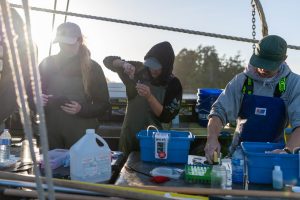
- Pit tagging and sampling juvenile Chinook to test for environmental stressors and track survival over their lifespan. Photo by Mack Bartlett (Ha’oom Fisheries Society and Juanes Lab, University of Victoria)
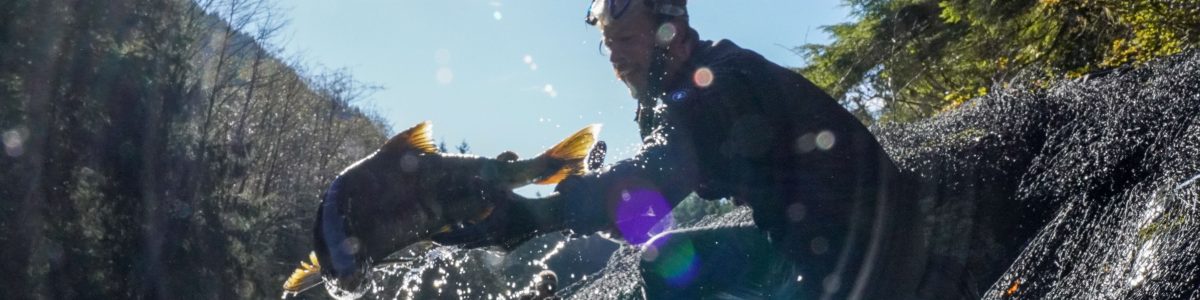
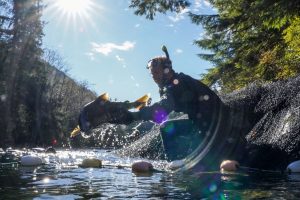
- Returning Chinook to the river after sampling to strengthen genetic baselines for rivers and monitor for hatchery strays from other systems. Photo by Craig Ludsen. Supplied by Ha’oom Fisheries Society.
Project partners: Indigenous Stewardship Fund, Pacific Salmon Foundation, Genome BC, Ha’oom Fisheries Society, Sutherland Bioinformatics, Vancouver Island University, Fisheries and Oceans Canada
###
Contact: Genie Tay, Communications Manager, Genome BC
Referenced project: GIF013