

Spit Happens! The History of 23andMe
Sarah Lando, Digital Communications Manager at Genome BC


IN THIS EPISODE
The story of 23andMe has more twists than a soap opera. Spit parties, ghosting the FDA, unicorn valuations, and massive data breaches—this company has done it all. In this Gene Short, Sarah Lando walks Dr. Kaylee Byers through the drama behind the headlines, and what it all means if you’re thinking about exploring your own ancestry DNA.
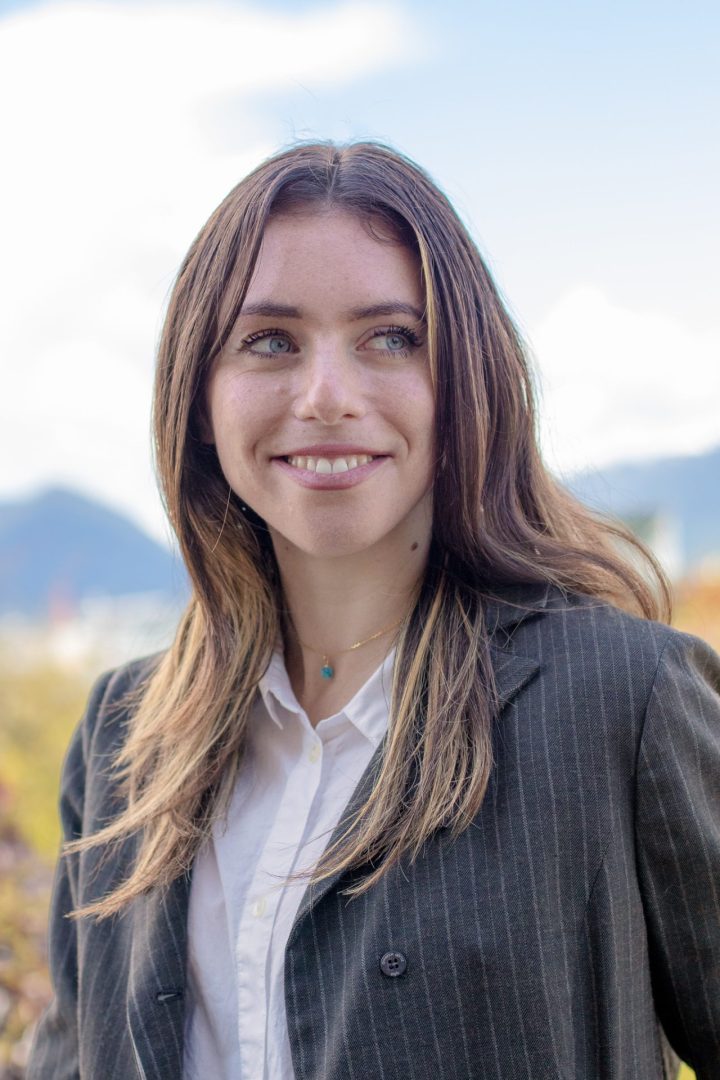
Sarah Lando, Digital Communications Manager at Genome BC
Sarah Lando is a digital storyteller and communications professional, currently serving as the Communications Manager, Digital Media at Genome British Columbia. With a decade of experience in digital communications, Sarah translates complex concepts into engaging and meaningful messages tailored to specific audiences. Collaborating with others and making genomics relevant and accessible to British Columbians and fostering a sense of inclusivity drives her work in this role.
Sarah’s journey in digital marketing began during her undergraduate studies at the University of British Columbia (UBC), where she honed her skills in creating and executing digital promotions for UBC’s varsity athletic. After her undergraduate studies, she furthered her passion with a post-undergraduate diploma in marketing communications at the British Columbia Institute of Technology (BCIT). It wasn’t long before Sarah was hired by the institution, where she helped to increase international enrolments through in-person and digital campaigns. One of her proudest achievements was leveraging current student influencers to share their positive experiences leading to a spike in applications from the influencers’ respective regions.
Sarah has had the opportunity to speak at events hosted by esteemed organizations, such as the Canadian Public Relations Society Vancouver, International Language Academy of Canada and the Canadian Association of Public Schools International.
RESOURCES
The rise and fall of 23andMe | Business Insider The rise and fall and rise again of 23andMe | NatureTRANSCRIPT
00:00:00
Sarah Lando: Kaylee, do you know much about your ancestry?
00:00:03
Dr. Kaylee Byers: I do actually. I know an almost absurd amount about my ancestry. I
have a great-great-great-great-grandmother who was hung in the Salem witch trials.
Someone also operated a guillotine. But they're separate. I will say they're separate
from each other.
00:00:19
Sarah Lando: I do have a lot of questions. I don't know very much about mine. I've
actually never looked into it. Have you ever been curious about learning more?
00:00:26
Dr. Kaylee Byers: Well, what I've learned so far has been quite dramatic. So yes. Yes
and cautiously.
00:00:32
Sarah Lando: Well, today I actually want to talk about the history of 23andMe, which is
even more eventful than a Salem witch trial. I don't know if you've been following the
rollercoaster that is 23andMe over the past almost 20 years, but it's a lot of drama. And
I'm going to tell you the whole saga in five minutes.
00:00:53
Dr. Kaylee Byers: That's ambitious and I love that. Let's do it. Start the clock.
00:00:58
Sarah Lando: The story begins back in 2006 when Anne Wojcicki, a biologist turned
Wall Street analyst, co-founds 23andMe with Linda Avey and Paul Cusenza. The
mission, disrupt healthcare by giving people access to their own DNA, not just for
ancestry, but to learn about health traits and disease risks based on their genetics.
Wojcicki had a plaque in her office that read, "I'm CEO, bitch." So that just gives you a
sense of her personality a little bit. Very live, laugh, love, boss babe. You know what I
mean?
00:01:32
Dr. Kaylee Byers: I love the idea of live, laugh, love also being in that office, and now it
makes me want to have both of these signs in my own office. I'm a scientist, bitch.
00:01:42
Sarah Lando: Yeah.
00:01:42
Dr. Kaylee Byers: Live, laugh, love.
00:01:43
Sarah Lando: Yeah, exactly. I don't know if I want to meet her, but I kind of do at the
same time, right?
00:01:47
Dr. Kaylee Byers: Yeah. You kind of want to be best friends from a distance. A
hundred percent.
00:01:50
Sarah Lando: Yeah, exactly. So in 2007, they launched their first spit-based test for a
whopping $ 999. Towards the start, they really leaned into that star power to create
initial buzz around these kits and hosted what they called spit parties, where celebrities
would take tests and talk about their genetic and ancestry results publicly. The company
was gaining a lot of attention, and in 2008 Time Magazine called their kit the invention
of the year. From 2008 to 2012, the kits were going down in price, making them way
more accessible, down from 999 to just $ 99. So more and more people could actually
buy these spit tests. And as that's happening, the company is quietly building one of the
world's largest genetic databases.
00:02:41
Dr. Kaylee Byers: I know there's a lot that you just shared with us, but I really can't get
over spit party. That feels like an interesting choice for branding. And I mean, good for
them. That's a lot of confidence. So there's lots of spit building up. That's exciting, and I
feel like we've got a butt coming.
00:02:58
Sarah Lando: Yeah, this is where we start to get into some of the first fumbles. During
this time, the FDA, the Food and Drug Administration, was worried people were getting
medical results without proper context, risking misunderstandings, unnecessary panic,
or false reassurance. So the FDA asked 23andMe to prove that their tests were
accurate, but the company did not respond for months, which is not a smart move when
the FDA is knocking on your door. Their lack of response inevitably ticked off the FDA,
and in 2013, they basically ordered them to stop providing health reports.
00:03:36
Dr. Kaylee Byers: Again, so much confidence. The FDA is like, “Hey, we got a
question." They're like, "I'm just going to ghost you."
00:03:41
Sarah Lando: Yeah, pretty much.
00:03:42
Dr. Kaylee Byers: I like it. Power move.
00:03:43
Sarah Lando: I mean, this is coming from a person who had a plaque that said, " I'm
CEO, bitch."
00:03:47
Dr. Kaylee Byers: Exactly. You know what? Vibes, all vibes.
00:03:50
Sarah Lando: So basically overnight, 23andMe had to strip all the health info from their
reports, leaving only ancestry data. And Wojcicki later admitted that there was a bit of
arrogance on their part in how they handled regulators. So self-aware, right? The
company had to rebuild its credibility, which they focused on for the next couple of
years. Then in 2015, they earned FDA approval, becoming the first U. S. company
allowed to sell direct to consumer genetic health tests. These included things like
Alzheimer's risk and BRCA variants, the genes that are linked to higher risks of breast
and ovarian cancer. By 2018, 23andMe was valued at over one billion, which made it a
Silicon Valley unicorn. And as I mentioned earlier, they'd been quietly building this
enormous genetic database from millions of customers, and they'd been using it to
conduct research. So by this point, they had published over 80 scientific papers based
entirely on their user data. They even launched a drug discovery division, betting that
this dataset could identify new drugs. So they started getting into pharma. One Stanford
cardiologist called it the largest genetic study the world has ever known.
00:05:06
Dr. Kaylee Byers: And I mean, what 23andMe was trying to do isn't inherently bad.
Like you said, they're doing research to spot disease patterns. They're trying to develop
new drugs. There's a ton of valuable science that can come out of these large datasets,
but that's a big but, it only works when it's done with really thoughtful governance.
Databases need to be secure, built with clear consent and actually represent the
diversity of the population. And there's some really great examples of researchers trying
to do this the right way. I know that Genome Canada is working to sequence 100,000
Canadian genomes to create a secure national data bank that actually mirrors the
country's diversity and the ideas to make healthcare more precise, effective and fair. So
yeah, big genomic datasets can do a lot of good, but with great power comes great
responsibility; done badly, can go off the rails pretty fast.
00:05:54
Sarah Lando: Exactly, Kaylee. And we're about to see where things really go south for
23andMe. So everything had been going really well, but around 2019, cracks started to
really show. Growth had slowed. I mean, you can only take a DNA test once, and
privacy worries got louder. The company had to lay off about a hundred employees,
which always kind of sparks a lack of confidence. 23andMe went public in 2021 in a
deal that did briefly value the company at about six billion, but the buzz faded quickly
and the stock dropped soon after. Then things got way, way worse.
00:06:35
Dr. Kaylee Byers: How much worse?
00:06:36
Sarah Lando: So to your point about ensuring data is handled with care, in 2023, a
massive data breach exposed information from seven million users, including sensitive
ancestry data. The breach wasn't detected for five months. As a result, 23andMe settled
a $ 30 million lawsuit and public trust in the company tanked. By 2024, 23andMe laid off
40% of staff, halted drug development and pulled out of the stock market.
00:07:06
Dr. Kaylee Byers: Sounds like things aren't going great.
00:07:08
Sarah Lando: Hot take. That hot take would be correct. So in March 2025, 23andMe
officially filed for bankruptcy. A biotech company moved to purchase the company's
asset for 256 million, but at the last minute, that boss bitch and Wojcicki outbid them
through her nonprofit, spending $ 305 million to win back control. Her new mission was
to rebuild 23andMe as a privacy first, science-driven organization, and that is where
23andMe stands today. The super abridged version of the rise and fall and rise again
and fall and rise one more time of 23andMe.
00:07:48
Dr. Kaylee Byers: I mean, I love a rollercoaster. Thank you for taking us on that wild
ride. Speaking of, did we make it in under five minutes?
00:07:54
Sarah Lando: Probably not, but we tried.
00:07:56
Dr. Kaylee Byers: That's really all that matters. It's the effort that counts.
00:07:59
Sarah Lando: Exactly. You just got to live, laugh, and love.
00:08:01
Dr. Kaylee Byers: You got to live, laugh, love. Well, that's another Gene Shorts in the
books. Keep your eyes peeled for more minisodes like this one and reruns of our
favorite nice genes moments. Don't forget to like and subscribe and leave a review. I'm
Dr. Kaylee Byers. Thanks for listening.

400–575 West 8th Avenue
Vancouver, BC V5Z 0C4 Canada

Host: Kaylee Byers
Creative Director: Jen Moss
Strategy: Roger Nairn
Producer: Jenny Cunningham
Partnership Manager: Sarah Lando
Audio Engineer: Patrick Emile
Cover Art Designer: Amanda Di Genova


© 2000–2026 Genome British Columbia All rights reserved. | Terms of Use | Privacy
